


Upcoming Speaking Engagements for Brought Forth on this Continent: Abraham Lincoln and American Immigration
2024
July 5, 4:30-9:00 PM • "Battle Hymns," a performance/fundraiser for the Gettysburg Foundation, with actor Stephen Lang, author Jeff Shaara, and musician Tim Cobb. Gettysburg National Military Park Museum & Visitor Center. See here for tickets.
July 8, 6:30 pm • Public talk, "Lincoln and the Uncivil War Over Immigration: From Ireland and Germany to Philadelphia and the Battlefield," at the "Freedom, Opportunity, and the History of Immigration" seminar, Freedom Foundation at Valley Forge ("Founding Forward"), Liberty Hill, 800 Ridge Pike, LaFayette Hill, PA; conversation continues with students, July 9, 9-11:30 AM.
July 17, 6:00 PM • Speaks on book Brought Forth on this Continent at Seward House, Auburn, NY: For more information email development@sewardhouse.org
August 8 • Debut of paperback edition of Monument Man: The Life and Art of Daniel Chester French, Chesterwood, Stockbridge, MA. Public performance at 5:30 M: "Mr. French Takes on Mr. Lincoln" with actor Rufus Collins. Tickets and information can be found here.
August 22, 6:00 PM • Speaks at St. Simon's Island, Georgia, Chautauqua on "Electing and Re-Electing Lincoln: The Immigrant Impact." St. Simon’s Presbyterian Church. To register, visit "www.coastalgeorgiahistory.org.
September 5 • Speaks on "Monument Man" at St. Botolph Club, Boston. For more information, email donnahassler@gmail.com.
September 21 • Albany (NY) Book Fair
October 16, 7 PM • Speaks at Plymouth Church, Brooklyn on Lincoln's 1860 visit. For more information, contact jameswwaechter@gmail.com.
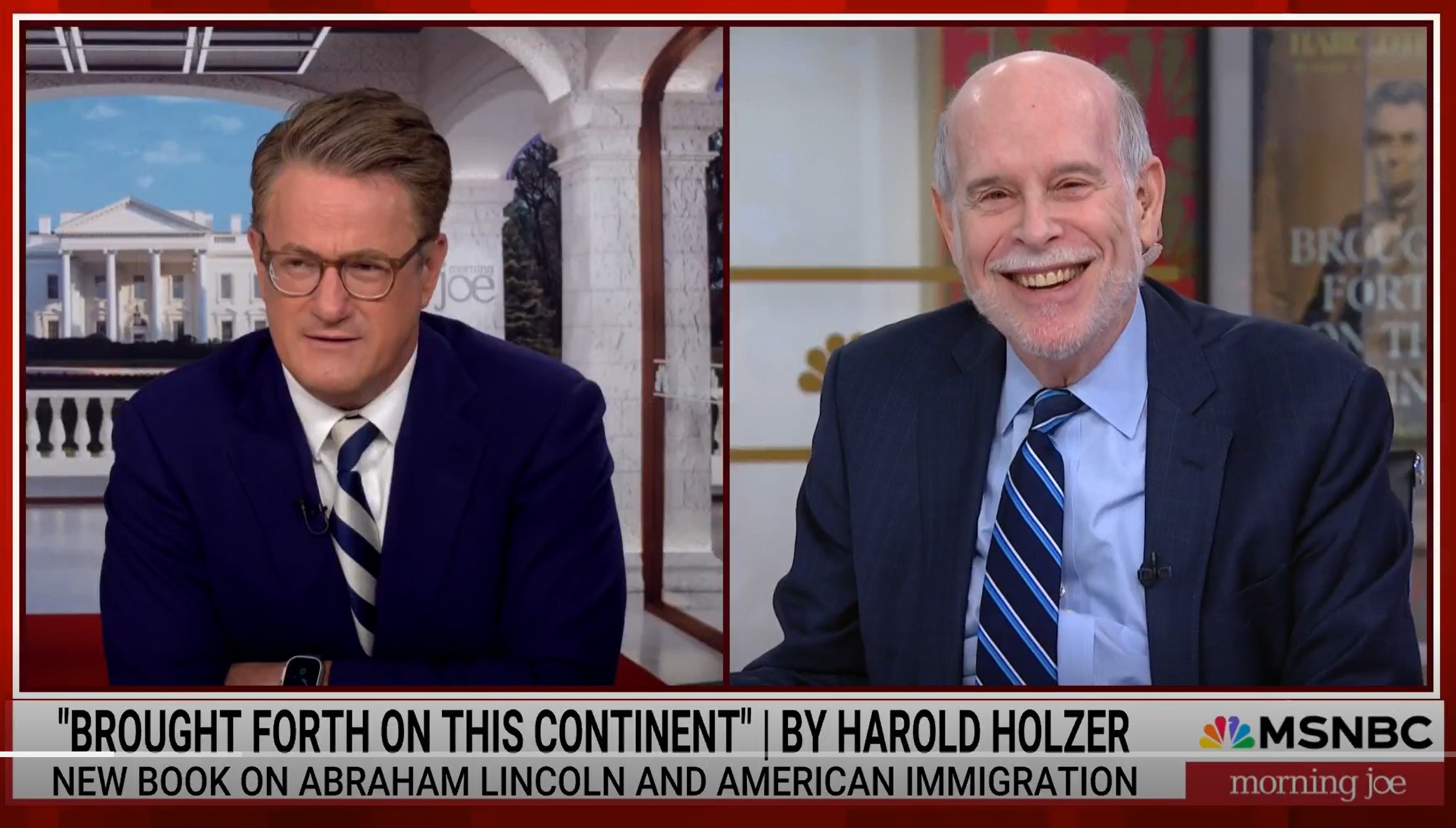
Harold talks with Joe Scarborough of MSNBC's Morning Joe about his new book, and how Lincoln evolved on immigration. Watch the segment here.
Editorial Reviews for Brought Forth on this Continent: Abraham Lincoln and American Immigration
"As a brilliant historian with a keen sense of the passions and problems of our own time, Harold Holzer has given us a powerful and illuminating study of Abraham Lincoln and immigration—an issue of perennial significance. Like Lincoln himself, Holzer’s new book is at once timely and timeless." – Jon Meacham, Pulitzer Prize–winning biographer and author of the New York Times bestseller And There Was Light
"Harold Holzer has unwrapped yet another profoundly meaningful gift from Abraham Lincoln. This deeply researched and beautifully written book not only breaks new ground, but the revelations come at a pivotal moment in American history when we must strive, like Lincoln, for a better future for Americans regardless of their race, religion, or national origin." – Doris Kearns Goodwin, Pulitzer Prize–winning and Lincoln Prize–winning author of Team of Rivals: The Political Genius of Abraham Lincoln
"In the 1850s, the issue of immigration proved as divisive in American politics as the issue of slavery. Many historians have written about Lincoln’s role in the latter controversy, but Harold Holzer is one of the few who has wielded his golden pen in treatment of the former, in this splendid book that also analyzes the Union president’s vital role in mobilizing the foreign-bornpopulationtohelpwintheCivilWar." – James M. McPherson, Pulitzer Prize–winning author of Battle Cry of Freedom: The Civil War Era and winner of the Lincoln Prize
"Harold Holzer, our most prolific chronicler of the life of Abraham Lincoln, here gives us a Lincoln with whom we are not familiar. Just as Lincoln’s views on emancipation and Black citizenship evolved, so too did his understanding of immigrants’ contributions not only to the Union war effort, but to American society more broadly. There is a lesson here for our ownfraughttimes." – Eric Foner, author of The Fiery Trial, winner of the Pulitzer Prize, the Bancroft Prize, and the Lincoln Prize
"Now comes Harold Holzer with another riveting revelation of Abraham Lincoln's life and times. Between these covers lie surprise after surprise, anecdote after anecdote, episode after episode that left me thinking how little has changed in America’s long debate over immigration—and how much like then it is now. You won’t forget this book." – Bill Moyers, former White House Press Secretary and broadcast journalist
"Lincoln scholar Holzer's latest book again demonstrates his deftness in blending a detailed focus on part of Lincoln's career, an explanation of how it fits into Lincoln's life, and a political and historical backdrop… Holzer brings part of America's past alive and shows that while modern immigrants come from different places, controversies about them are the same as generations ago." – Booklist, starred review
"An outstanding and important book on Lincoln and immigration. A must for readers of American history and immigration studies." – Library Journal
"Historian Holzer offers an elegant examination of Abraham Lincoln's political evolution on the contentious issue of immigration... This robust and lively account makes cogent connections between history and today's immigration policy that will resonate with a wide readership." – Publishers Weekly
"Readable history... Of considerable interest to students of 19th-century American history as well as of the Civil War." – Kirkus
Harold is on Twitter! Follow Harold for insights on Lincoln, updates on appearances, and general musings and behind-the-scenes photos.
Follow @haroldholzer

 |
|
| |
|
ORDER NOW |
|
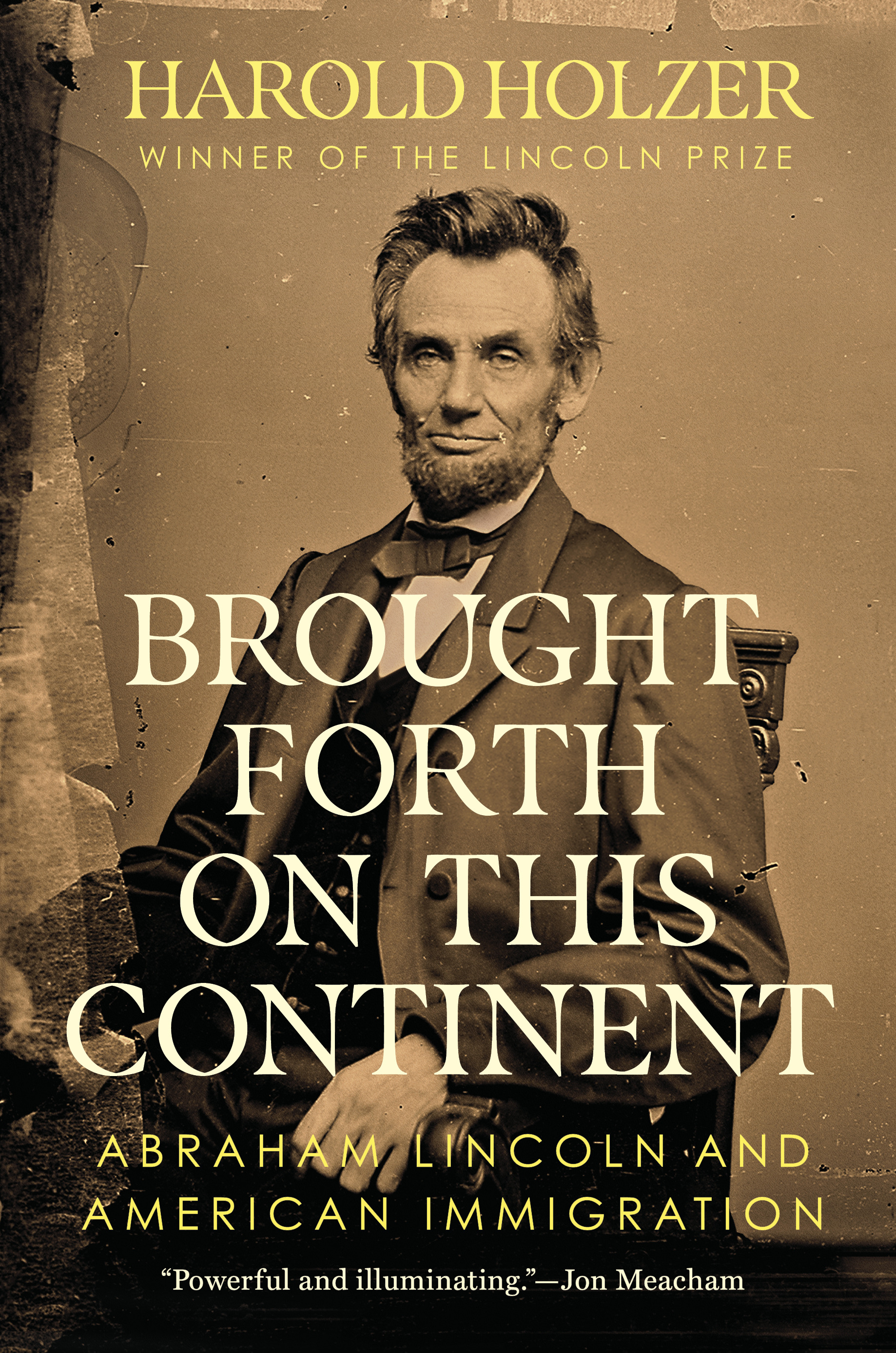
| In the three decades before the Civil War, some ten million foreign-born people settled in the United States, forever altering the nation’s demographics, culture, and—perhaps most significantly—voting patterns. America’s newest residents fueled the national economy, but they also wrought enormous changes in the political landscape and exposed an ugly, at times violent, vein of nativist bigotry. Abraham Lincoln’s ascent ran parallel to this turmoil; even Lincoln himself did not always rise above it. Tensions over immigration would split, and ultimately destroy, Lincoln’s Whig Party years before the Civil War. Yet the war made clear just how important immigrants were, and how interwoven they had become in American society. Harold Holzer charts Lincoln’s political career through the lens of immigration, from his role as a member of an increasingly nativist political party to his evolution into an immigration champion, a progression that would come at the same time as he refined his views on abolition and Black citizenship. As Holzer writes, "The Civil War could not have been won without Lincoln’s leadership, but it could not have been fought without the immigrant soldiers who served and, by the tens of thousands, died that the ‘nation might live.’" An utterly captivating and illuminating work, Brought Forth on This Continent assesses Lincoln’s life and legacy in a wholly original way, unveiling remarkable similarities between the nineteenth century and the twenty-first. |
|
 |
|
The Presidents vs. the Press: The Endless Battle Between The White House and the Media—From the Founding Fathers to Fake News |
|
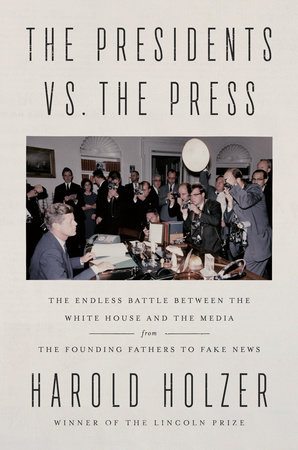
| "The FAKE NEWS media," Donald Trump has tweeted, "is not my enemy. It is the enemy of the American people." Never has our free press faced so great a threat. Yet the tension between presidents and journalists is as old as the republic itself. From George Washington to Trump, presidents have quarreled with, attacked, denigrated, and manipulated the fourth estate. Washington groused about his treatment in the newspapers, but his successor, John Adams, actually wielded his executive power to overturn press freedoms and prosecute critical reporters. Thomas Jefferson tapped a reporter to find dirt on his rival, Alexander Hamilton, only to have the reporter expose his own affair with his slave Sally Hemings. (Jefferson denied the reports out of hand—perhaps the first presidential cry of "fake news.") Andrew Jackson rewarded loyal newspapers with government contracts; Abraham Lincoln shuttered critical papers and imprisoned their editors without trial. FDR and JFK charmed journalists in order to protect their personal secrets, while Nixon cast the press as a public enemy for daring to investigate his own. In this remarkable new account, acclaimed scholar Harold Holzer guides readers through the clashes between chief executives and journalists, showing how these battles were waged and won, while girding us for a new fight to protect our nation’s greatest institution: a free and functioning press. |
|
|
|
|
|
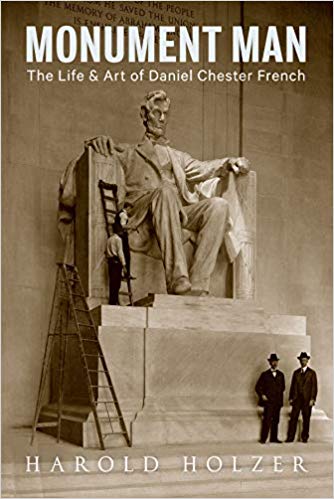
| The artist who created the statue for the Lincoln Memorial, John Harvard in Harvard Yard, and The Minute Man in Concord, Massachusetts, Daniel Chester French (1850–1931) is America's best-known sculptor of public monuments. Monument Man is the first comprehensive biography of this fascinating figure and his illustrious career. Full of rich detail and beautiful archival photographs, Monument Man is a nuanced study of a preeminent artist whose evolution ran parallel to, and deeply influenced, the development of American sculpture, iconography, and historical memory. | |
|
|
| Lincoln and the Power of the Press: The War for Public Opinion Harold Holzer |
|
| Holzer shows us an activist Lincoln through journalists who covered him from his start through to the night of his assassination when one reporter ran to the box where Lincoln was shot and emerged to write the story covered with blood. In a wholly original way, Holzer shows us politicized newspaper editors battling for power, and a masterly president using the press to speak directly to the people and shape the nation. | |
|
|
|
|
|
|
|
|
|
|
|
|
|
|
|
|
|
|
|
|
|
|
|
|